

Generic selectors
Exact matches only
Search in title
Search in content
Post Type Selectors

Turning Tool Types, Materials, and Their Characteristics

The lathe tool, or turning tool is one of the most important tools used in machining operations, as it performs the actual cutting process on the rotating workpiece. The basic principle of turning is that the workpiece rotates, while the tool remains stationary, or moves in a radial direction, enabling precise and efficient material removal.

Selecting the right turning tool is crucial, as parameters such as spindle speed, cutting speed and depth of cut. These factors directly affect machining quality, productivity and tool life.

Parts of a modern turning tool

  • Cutting edge: The cutting edge performs the actual cutting and has a direct impact on cutting performance and surface finish.
  • Relief angle: Reduces friction between the workpiece and the tool, thereby slowing tool wear.
  • Wedge angle: Influences the strength of the tool and the cutting forces. A smaller angle enables easier cutting, while a larger angle provides greater durability.
  • Rake angle: Plays a key role in chip evacuation. A positive rake angle is generally suitable for softer materials, while a negative rake angle is better suited to harder materials.
  • Nose radius: Determines the smoothness of the machined surface and the tool’s resistance to wear.

Classification of turning tool types

The classification of turning tools is no longer based solely on the traditional “single-point tool” design. Modern technologies and industrial requirements have led to the use oftool holders and indexable insert tooling widespread.
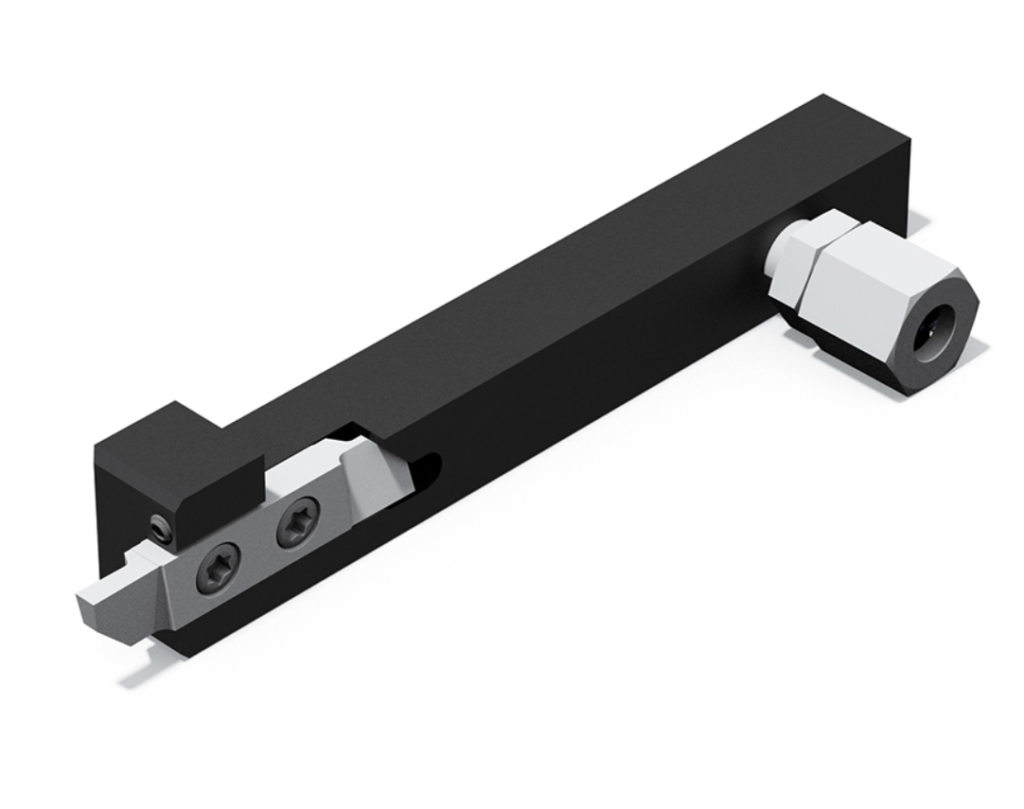
By function and application
Straight turning tool (or its indexable insert equivalent)
  • Application: For turning longitudinal or straight surfaces.
  • Modern solution: Tool holders and indexable inserts, where the insert geometry determines the cutting angle and performance.
Facing tool
  • Application: For machining angled or curved surfaces.
  • Note: The replaceable inserts provide the required cutting angles, while the tool holders securely hold the tool in place.
Threading tool
  • Application: Used for cutting threads.
  • Modern technology: A combination of threading inserts and tool holders that enables precise and fast thread machining.
Drilling and boring tool
  • Application: Used for internal boring operations.
  • Key feature: Internal boring is performed using a combination of tool holders and inserts to ensure stable tool clamping.
Knurling tool
  • Application: For creating specialized knurled surfaces.
  • Modern design: Nowadays, special tool heads and roller-based solutions are used for knurling, ensuring a precise knurled pattern.
Parting and grooving tools
  • Application: For grooving and parting off workpieces.
  • Modern clamping method: Indexable inserts are often secured without screws, using a tensioned clamping system that holds the insert firmly in its seat.
Esztergaszerszám
By turning tool material

Choosing the right turning tool material is crucial for efficient machining. The hardness of the workpiece material and the intensity of the cutting process determine which tool material is most suitable. Below, we present the most common turning tool materials and their key characteristics.

Carbide tool
  • Characteristics: High wear resistance and excellent heat resistance.
  • Applications: Ideal for high cutting speeds and high-volume material removal.
  • Advantage: Well suited for hard materials and high-volume production.
High-speed steel (HSS) tool
  • Characteristics: More flexible and less brittle than carbide.
  • Applications: For lower machining speeds, such as small-batch or manual turning.
  • Advantage: Good value for money, easy to resharpen, and effective even with low material removal rates.
Ceramic tool
  • Characteristics: Excellent heat resistance and high wear resistance.
  • Applications: At high cutting speeds, mainly for machining carbide and hardened materials.
  • Advantage: Minimal heat input into the workpiece and longer tool life.
Cermet (a ceramic–carbide composite)
  • Characteristics: Combines the durability of carbide with the heat resistance of ceramic.
  • Applications: For machining extremely hard and abrasive materials, such as hardened steels.
  • Advantage: Enables precise machining at high speeds with a long tool life.
Classification of turning tools by geometry

Turning tools can also be classified according to their shape and the geometry of their cutting edge. These characteristics determine the machining direction, cutting efficiency, and final surface quality.
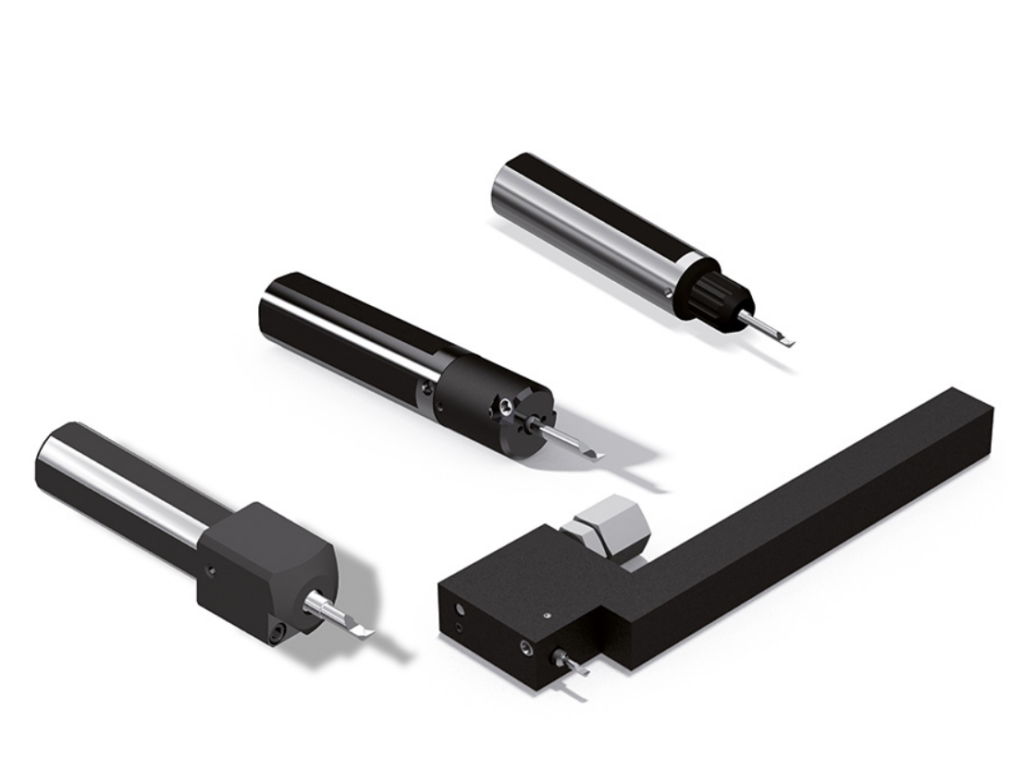
Right-hand or left-hand tools
  • Key feature: Classified according to the direction of machining
  • Jobbkezes: Cutting is performed from right to left.
  • Balkezes: Cutting is performed from left to right.
  • Applications: The appropriate tool direction is selected based on the workpiece and machining conditions.
Long-edge or short-edge tools
  • Key feature: The length of the cutting edge determines the application.
  • Long-edge tool: deal for machining larger surfaces, such as longitudinal turning.
  • Short-edge tool: Used for precision work and machining smaller surfaces.
  • Criterion: A longer cutting edge is more effective at greater depths of cut but wears out faster.
Indexable insert turning tool
  • Key feature: Replaceable cutting inserts are secured in the tool holder and can be changed quickly and easily.
  • Advantage:
  • Higher productivity thanks to quick insert changes.
  • Widely applicable with inserts of different geometries, such as varying nose radii and edge designs.
Special geometric properties
  • Internal-cooling tool holders:
  • In modern turning tools, internal cooling allows the coolant to be directed precisely into the cutting zone. This improves chip evacuation, reduces heat, and extends tool life.
  • Insert nose radius:
  • Small nose radius: Provides a better surface finish and lower surface roughness, but is more fragile and suitable for lower cutting parameters.
  • Large nose radius: More effective and durable at greater depths of cut, but provides less precise surface quality.
  • Parting inserts:
  • Right-hand, left-hand, and neutral designs: They can be selected according to the direction of parting or grooving of the workpiece.
  • The inserts feature different geometries (e.g. negative or positive rake angles) to suit the machined material and the desired cutting parameters.
Esztergaszerszám
According to the cutting angle

Cutting angles, such as the wedge angle, rake angle, and clearance angle, determine cutting efficiency, tool wear, and surface quality. Selecting the appropriate combination of angles is crucial for efficient and economical machining.

Tools with a smaller clearance angle
  • Key feature: A larger contact area with the workpiece, improving material removal efficiency.
  • Disadvantage: Increased friction results in faster tool wear.
  • Applications: Used when high material removal rates are required and fast cutting is important.
Tools with a larger clearance angle
  • Key feature: Provides finer and more precise machining by reducing friction between the tool and the workpiece.
  • Advantage: Results in longer tool life with less wear.
  • Applications: Ideal for precision work requiring high surface quality, such as final finishing operations.
Chip breaker edge design

The chip breaker edge's design is crucial for proper chip removal and control. During cutting, the size, shape, and direction of the chips produced depend largely on the tool’s chip breaker geometry.

  • Chip breaker inserts: Modern indexable turning tools are available with various chip breaker designs, which can be optimized according to the type of material being machined and the cutting parameters.
  • For softer materials: A finer chip breaker geometry helps break up long, tangled chips.
  • For harder materials: A more robust chip breaker design is required for effective chip evacuation.
  • Advantages of chip breaking:
  • Prevents chips from wrapping around the workpiece or the tool.
  • Improves workplace cleanliness and safety.
  • Reduces thermal and mechanical loads on the tool and workpiece.
Coatings for extending the service life of turning tools.

The coating of turning tools plays a key role in increasing wear resistance, the heat resistance and tool life. Selecting the appropriate coating significantly affects cutting performance, especially when machining at high speeds or working with hard materials.

TiN (Titanium Nitride) coating
  • Key feature: Gold-colored, extremely hard coating.
  • Advantage: Significantly increases wear resistance and reduces friction.
  • Applications: Ideal for general-purpose machining at low to medium cutting speeds.
TiAlN (Titán-alumínium-nitrid) bevonat
  • Key feature: A darker-colored coating that, due to its higher aluminum content, provides better resistance to high temperatures.
  • Advantage: High heat resistance, which is particularly useful during high-speed cutting.
  • Applications: Used for harder materials, heavy-duty machining, and turning at high cutting speeds.
PVD and CVD coatings
PVD (Physical Vapor Deposition – Physical Vapour Deposition):
  • Key feature: The coating is thin, yet extremely hard, with precisely controllable thickness.
  • Advantage: Good adhesion, excellent wear resistance, and lower heat input into the tool.
  • Applications: For precision machining where long tool life is important.
CVD (Chemical Vapor Deposition – Chemical Vapour Deposition):
  • Key feature: Produces a thicker coating that remains stable even at higher temperatures.
  • Advantage: Provides more durable protection during heavy-duty machining.
  • Applications: Used for machining harder and more abrasive materials.
Based on special applications

Specialized turning tools and inserts are required for unique machining tasks, increasing efficiency and the accuracy of the final result. Thanks to their optimized shape and function, these tools speed up the work, and improve surface quality,especially when machining complex components.

Roughing tool
  • Application: For rough machining, where the goal is rapid material removal.
  • Key feature: The roughing tool is designed to operate at high depths of cut and feed rates, thereby maximizing productivity.
  • Modern application: Modern indexable roughing tools feature efficient chip breaker designs that speed up machining and reduce heat generation.
Finishing tool
  • Application: For fine surface finishing where a precise and smooth final result is of primary importance.
  • Key feature: Operates with a smaller depth of cut and lower feed rate, providing excellent surface finish.
  • Role of the nose radius: A smaller nose radius produces a more precise surface finish, but requires lower cutting parameters.
Profile insert
  • Application: For producing complex surfaces that require an accurate geometric profile.
  • Key feature: The insert incorporates the desired geometry, allowing the required shape to be produced in a single pass reducing the need for small, fine movements.
  • Advantage:
  • Faster and easier machining.
  • The surface quality remains consistent because the insert’s geometric design ensures precision.
Internal coolant holders and high-pressure cooling
  • Application: For delivering coolant-lubricants in a concentrated manner, especially in confined spaces or when machining complex component geometries.
  • Key feature: Internal coolant holders deliver the coolant directly to the cutting zone, thereby:
  • Reducing heat generation during machining.
  • Improving chip breaking and preventing chip accumulation.
  • They are particularly useful for internal turning or machining in confined spaces, where chip evacuation can be difficult.
  • Modern technology: High-pressure cooling systems are becoming increasingly common. They deliver the coolant forcefully into the cutting zone, thereby increasing productivity and extending tool life.

Which turning tool should be used when in practice?

The selection of the appropriate turning tool depends on the material being machined, the cutting speed and the specific task. Modern manufacturers, such as Applitecprovide detailed tables for different material grades and the optimal cutting parameters for each. These recommendations greatly assist in selecting the right tool to maximize both workpiece quality and tool life.

Selection based on material
Turning steel
  • Recommended tool: Turning tool equipped with carbide or cermet inserts.
  • Parameters: Medium or high cutting speed, with an optimal cutting-edge angle suited to the material’s hardness.
  • Typical application: General machining, thread cutting, or roughing.
Turning aluminum
  • Recommended tool: Carbide inserts with a positive cutting edge and a larger rake angle.
  • Parameters: High cutting speed, a sharp insert, and a smaller nose radius for a clean surface finish.
  • Typical application: Fine finishing operations and light material removal.
Turning stainless steel
  • Recommended tool: Highly wear-resistant carbide or ceramic inserts with a chip-breaker design.
  • Parameters: Moderate cutting speed, but a higher feed rate for stable chip breaking.
  • Typical application: Precision machining and machining of difficult-to-cut materials.
Selection based on the type of operation
Rough machining (roughing)
  • Tool: Carbide inserts with a larger cutting-edge angle and a robust design.
  • Key feature: Rapid material removal at a large depth of cut.
Fine machining (finishing)
  • Tool: Inserts with a smaller nose radius and a positive rake angle design.
  • Key feature: Achieving precise surface roughness with a low depth of cut and feed rate.
Internal machining
  • Tool: Internal coolant boring bars or indexable drills.
  • Key feature: Use of high-pressure coolant to optimize chip breaking and heat management.
Thread turning
  • Tool: Threading tool equipped with a profile insert.
  • Key feature: Creating custom or standard thread profiles.

Maintenance and resharpening

In the past, resharpening solid turning tools was common practice, but changes in tool geometry and reduced accuracy have made this approach less effective today. Resharpening modern coated tools is time-consuming and costly, so with the rise of indexable insert technology, simple tool replacement has largely replaced traditional maintenance. Proper cutting parameters and modern cooling solutions help extend tool life, while quick insert changes ensure accurate and continuous machining.

Summary

Turning tool types are fundamental elements of metal cutting, influencing machining efficiency, accuracy, and surface quality. The selection of the appropriate tool depends on the material being machined, cutting parameters, tool material, and specific machining requirements.


Alongside major manufacturers, specialized companies such as Applitec also offer excellent solutions for precision and micromachining applications. Innovative turning tool products, whether for milling, drilling, or specialized applications, improve productivity in the long term and ensure high-quality results.

Applitec catalogue: View